Describe the Properties of Ionic Compounds
What is the correct formula for this compound. The ionic bond is the attraction between positive and negative ions in a crystal and compounds held together by ionic bonds are called ionic compounds.
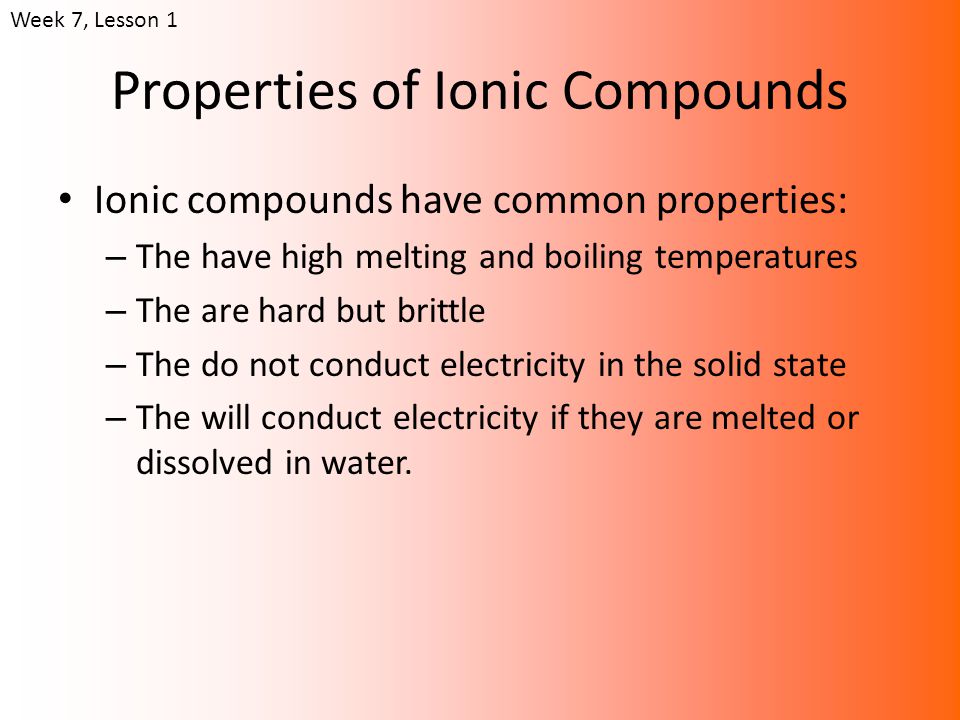
Chapter 6 Ionic Compounds Ppt Video Online Download
All of the above.

. If the solid is heated until it melts the liquid will conduct electricity because the ions are mobile they can move. 100 4 ratings Transcribed image text. Other physical properties of ionic compounds.
For the most part ionic compounds contain a metal bonded to a nonmetal. Examples of ionic compounds include pyrite FeS 2. Form when metals react with nonmetals exist as crystalline solids hard and brittle high melting points because the attractive forces between ions intramolecular forces are stronger high boiling points because the attractive forces between ions are stronger.
Most ionic compounds are solids that typically melt at high temperatures and boil at even higher temperatures. Ionic compounds are solids These compounds have high boiling and melting points. Describe Properties of Ionic Compounds.
Ionic compounds form crystals typically have. Conduct electricity when dissolved in water. Ionic Compound Properties 1.
Ionic compounds tend to have high melting and boiling points Ionic compounds are very hard and very brittle Ionic compounds conduct electricity when they dissolve in water. A compound that contains two or more ions and is held together by ionic bonds. The ions are easily hydrated by water molecules to form hydrated ions.
Physical Properties of Ionic Compounds Melting Points Because of the many simultaneous attractions between cations and anions that occur ionic crystal lattices are very strong. These electron pairs are known as shared pairs or bonding pairs and the stable balance of attractive and repulsive forces between atoms when they. A positively charged ion ie one that would be attracted to the cathode in electrolysis.
High melting and booking point. It is soluble in water. Ionic compounds are solids are somewhat hard because of strong force of attraction between the positive and negative ions.
They have higher enthalpies of fusion and vaporization than molecular compounds. In a giant ionic lattice there are strong electrostatic forces of attraction acting in all. Properties of ionic compounds Ionic compounds have regular structures called giant ionic lattices.
The compound consist of positively charged ions and negatively charged ions which make it neutral. Want to read all 13 pages. The solubility of ionic compounds in organic solvents can be explained as below.
Experts are tested by Chegg as specialists in their subject area. Due to the presence of the strong force of attraction between the positive. Examples include NaCl NaI and so on.
It is a hard solid. An ionic bond between oppositely charge ions. They are generally made up of two electrons which are shared by two atoms.
All ionic compounds are solid at room temperature. Upload your study docs or become a Course Hero member to access this document Continue to access End of preview. An ionic bond between oppositely charge ions.
Metals form cations by loosing electrons and. They are usually soluble in water and insoluble in solvents such as petrol kerosene etc. Due to the presence of electrostatic forces.
Describe the properties of ionic compounds Question The strong attraction between ions that make up an ionic compound is due to which of the following. The process of melting an ionic compound requires the addition of large amounts of energy in order to break all of the ionic bonds in the crystal. Ionic compounds hold a strong force of.
Upload your study docs or become a. The number of electrons lossed or gained by each ion. Ionic bonds are strong.
Melting and boiling points of ionic compounds. We review their content and use your feedback to keep the quality high. When electricity flows through an ionic compound the ions.
As a result ionic compounds are usually soluble in water. Dissolve in water and not organic solvent. As a result of how ionic compounds form their general properties include the following.
The properties of ionic compound include. High melting points High boiling points They are generally hard and brittle They are electrically neutral They form efficient insulators High enthalpies of fusion thermal energy needed to melt one mole of the solid form and vaporization thermal energy needed to vaporize one mole of the liquid form. Ionic compounds are composed of ions.
Properties of Ionic and Covalent Compounds One way of classifying chemical compounds is by whether they contain ionic bonds or covalent bonds. The transfer of electrons from the metal to the non-metal. Properties of ionic compounds.
There are many properties. Select all that apply. Ionic compounds are generally soluble in water insoluble in solvents such as kerosene petrol etc 4.
These compounds are formed through sharing of electrons and ionic compounds are formed by transferring of electrons. They have high melting points and also high boiling points. The transfer of electrons from the metal to the non-metal.
Physical properties of ionic compounds. It conducts electricity in molten state and in aqueous solution. Ionic compounds form crystal lattices rather than amorphous solids.
Covalent compounds break apart into molecules when dissolving in water because they are non-polar. The four properties of Ionic compounds are. The sharing of electrons electrostatic forces between ions of opposite charges o the attraction of anions to one another the number of neutrons in each atom.
The hydration of ions by water molecules liberates heat energy. Remember that an ionic bond is formed through the transfer of electrons. Solid ionic compounds do not conduct electricity because the ions are not free to move.
Thus electrons in the covalent compound are less mobile. Here is a short list of main properties. Ionic compounds have high melting and boiling points.
It is an ionic compound. An ionic compound is a compound held together by ionic bonds. Describe the properties of ionic compounds Question Copper II iodide is formed from the Cu2 cation and the l anion.
Ionic Compound Properties

Physical Properties Of Ionic Compounds Ck 12 Foundation
Properties Of Ionic Compounds Chemistry Quiz Quizizz
0 Response to "Describe the Properties of Ionic Compounds"
Post a Comment